Discovering bed bugs in your home is one of the most stressful experiences a Toronto resident can face. The anxiety is immediate, the disruption is significant, and the urgency to fix the problem quickly can push people toward the first exterminator they find rather than the right one. In North York, where dense apartment buildings, high-rise condos, and older housing stock create above-average conditions for bed bug spread, choosing the wrong exterminator is not just a financial mistake. It means living through a failed treatment, rebooking with a different company, and starting the entire process over while the infestation continues to grow.
This guide walks through every step of finding the best bed bug exterminator in North York so that when you make the call, you are choosing based on knowledge rather than desperation. From understanding the treatment methods available to knowing exactly what questions to ask before booking, the information here reflects what genuinely matters when selecting a qualified pest control professional for a bed bug problem in the Toronto market.
Why Finding the Right Exterminator Matters More Than Most People Realize
Most residents assume bed bug extermination is a straightforward service. Call a company, they treat the room, problem solved. The reality is more complicated. Bed bug treatments vary significantly in method, effectiveness, scope, and follow-up protocol. A company that applies a basic chemical spray and leaves without a warranty or follow-up visit delivers a very different outcome from one that uses a multi-method approach with a guaranteed return visit if any activity is detected within thirty days.
What Happens When You Choose the Wrong Company
A failed bed bug treatment leaves residents in a worse position than before booking. The disruption of preparing the home, the expense of the initial treatment, and the emotional toll of believing the problem was resolved followed by the realization that it was not combine into an experience that is genuinely difficult. Beyond the personal cost, a failed treatment in a multi-unit building can allow the infestation to spread further through shared walls, electrical conduits, and plumbing passages before the problem is addressed properly.
The Real Cost of a Failed Treatment
The financial cost of a failed treatment goes beyond the refund or re-treatment fee. Residents in North York who have gone through multiple treatment rounds from under-qualified companies consistently report the same pattern. The initial cheap quote looks appealing. The treatment either does not cover the full scope of the infestation or uses methods inappropriate for the specific bed bug population. Activity resumes within weeks. A second company is called. The total cost of two inadequate treatments plus the correct third treatment always exceeds what a qualified company would have charged from the start.
Step 1: Confirm You Are Actually Dealing With Bed Bugs
Before calling any exterminator, confirming that what you are dealing with is actually bed bugs rather than a different pest saves time, money, and the disruption of unnecessary treatment preparation.
What Bed Bugs Look Like and Where They Hide
Adult bed bugs are roughly the size of an apple seed, flat and oval when unfed, and reddish-brown in color. After feeding they become more elongated and darker. Nymphs are smaller and lighter in color, almost translucent in early stages. Bed bug eggs are tiny, white, and roughly one millimeter long, typically found in clusters in protected areas near sleeping surfaces.
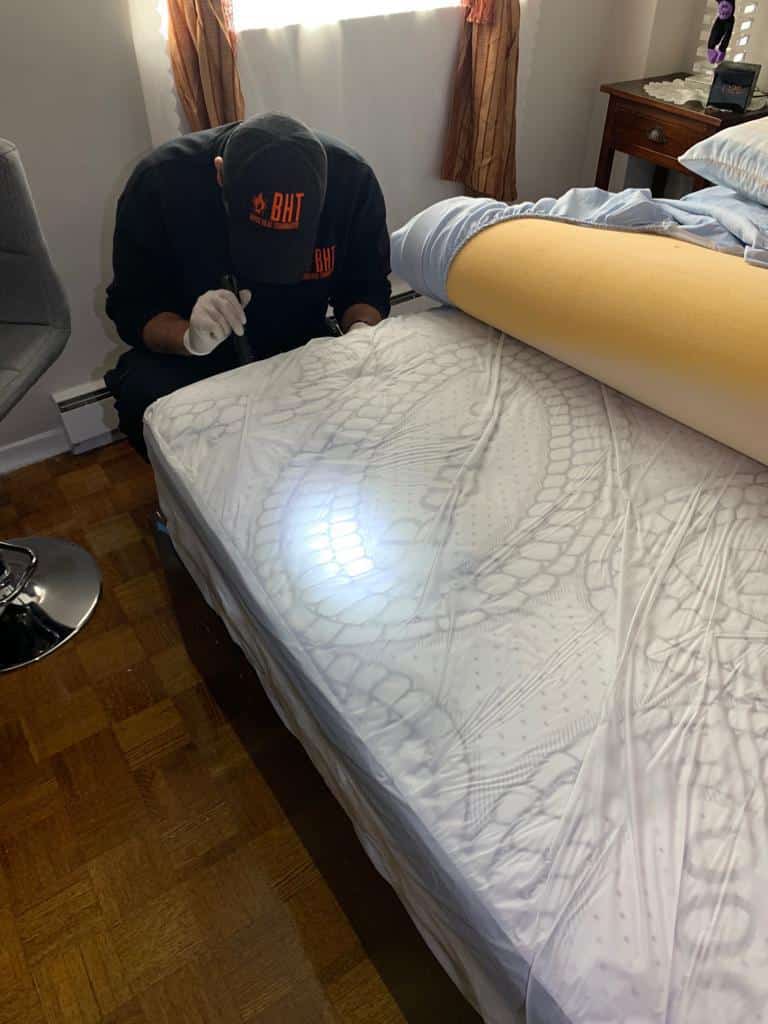
Common hiding locations include the seams and tufts of mattresses and box springs, the joints and screw holes of bed frames and headboards, behind baseboards and electrical outlet covers, inside nightstand drawers and picture frames, and within the folds of upholstered furniture. In North York’s older apartments and condos, bed bugs also commonly travel through wall voids, spreading from unit to unit without ever crossing a visible threshold.
Signs That Confirm an Active Infestation
The most reliable signs of an active bed bug infestation are small bloodstains on bedding from crushed bugs after feeding, dark rust-colored fecal spots on mattress seams and nearby surfaces, shed skins at various stages of development, and a sweet, musty odor that develops in heavily infested areas. Bite marks alone are not a reliable confirmation because individual reactions vary significantly and other insects cause similar skin reactions. Collecting a physical specimen or photographing one before calling an exterminator helps any qualified company assess the situation accurately before arriving.
Step 2: Understand the Treatment Methods Available in North York
A key differentiator between bed bug exterminators in the North York and Toronto market is the range of treatment methods they offer. Companies limited to a single approach cannot always match the treatment to the specific infestation characteristics, the property type, or the resident’s preferences around chemical exposure.
Bed Bug Heat Treatment
Heat treatment uses professional heating equipment to raise the temperature throughout the treated space to levels that kill bed bugs and their eggs at all life stages. The process typically runs for several hours and reaches temperatures between 49 and 57 degrees Celsius throughout the room. Heat treatment is particularly effective for reaching hiding spots that chemical sprays cannot penetrate, including inside walls, deep within furniture, and behind baseboards. It is also the preferred option for residents with sensitivity concerns around chemical pesticides and for families with young children or pets.
Conventional Chemical Treatment
Chemical treatment uses professional-grade insecticides applied to specific surfaces, harborage areas, and travel routes. An effective chemical treatment involves multiple product types including residual sprays, contact killers, and dust formulations applied in combination to address adults, nymphs, and eggs across different areas of the treated space. Professional chemical treatment done correctly requires at least two visits because eggs are not killed by most chemical products and must be addressed when they hatch during the follow-up application.
Aprehend Biopesticide Treatment
Aprehend is a biological pesticide that uses Beauveria bassiana, a naturally occurring fungal pathogen that infects and kills bed bugs on contact. The treatment is applied in targeted bands near bed bug travel routes. Bed bugs that cross the treated areas pick up the fungal spores and carry them back to harborage sites where the spores spread to other bugs in the colony. Aprehend provides residual activity for up to three months after application and is particularly valuable for situations where chemical resistance is a concern or where repeated chemical exposure is not desirable. Very few pest control companies in the GTA offer Aprehend as part of their treatment menu, which makes it a genuine differentiator for companies that carry it.
Why Multiple Treatment Options Matter When Choosing a Company
A company that offers only one treatment method applies that method regardless of whether it is the most appropriate choice for the specific infestation. High-rise condos with suspected inter-unit spread may benefit from a different approach than a ground-floor apartment with a contained single-room infestation. Residents with chemical sensitivities need non-chemical options. Infestations that have survived previous chemical treatments may have developed resistance that makes heat or biopesticide treatment the more effective choice. Choosing a bed bug exterminator in North York that offers multiple treatment methods means the recommendation you receive reflects your actual situation rather than the company’s equipment limitations.
Step 3: Know What Credentials to Look For
Credentials separate qualified pest control professionals from unlicensed operators, and in Ontario the distinction has regulatory backing.
Certifications and Licensing in Ontario
Pest control operators in Ontario must be licensed under the Pesticides Act and hold a valid Exterminator License issued by the Ministry of the Environment, Conservation and Parks. Ask any company you are considering to confirm their license number before booking. A licensed exterminator has completed formal training in pesticide application, safety protocols, and pest biology that unlicensed operators have not. Never book with a company that cannot immediately confirm their Ontario Exterminator License number.
Beyond the provincial license, look for membership in professional associations such as the Canadian Pest Management Association (CPMA) or Structural Pest Management Association of Ontario (SPMAO). These memberships require ongoing education and adherence to professional standards that add a layer of accountability beyond the basic provincial license.
Years of Experience in the Toronto Market
Experience in the specific Toronto and North York market matters for bed bug extermination because local housing stock, building types, and infestation patterns create conditions that technicians familiar with the area navigate more effectively. A company with ten or more years of experience treating bed bugs in GTA high-rises, older apartment buildings, and mixed residential developments has encountered the full range of infestation scenarios that North York properties present.
Step 4: Ask the Right Questions Before Booking
A qualified bed bug exterminator welcomes detailed questions before booking. The way a company responds to your questions tells you as much about their professionalism as the answers themselves.
Questions About the Treatment Process
Ask which specific treatment method is recommended for your situation and why. Ask how many visits are included in the quoted price and what happens if activity is detected after the initial treatment. Ask whether the treatment covers the full unit or only specific rooms. Ask which specific products will be applied and whether they are appropriate for homes with children or pets. Ask how long you will need to vacate the property after treatment and when it is safe to return.
Questions About Guarantees and Follow-Up
Ask specifically what the warranty or guarantee covers. A meaningful warranty includes a return visit within thirty days if any live bed bug activity is detected after treatment. Some companies offer extended warranties of sixty or ninety days on heat treatments because of the comprehensive nature of thermal eradication. Get the warranty terms in writing before the technician arrives. Any company that cannot provide written warranty terms before booking is signaling that the guarantee is verbal rather than contractual.
Step 5: Understand What the Treatment Preparation Involves
Every bed bug treatment requires resident preparation, and inadequate preparation is one of the most common reasons treatments underperform. Knowing what preparation involves before booking helps you plan realistically for the disruption.
What You Need to Do Before the Technician Arrives
For chemical treatments, residents typically need to wash all bedding and clothing in hot water and dry on high heat, bag and seal clean items, remove clutter from floors and under beds to allow full access to harborage areas, pull furniture away from walls, and vacate the property for several hours after application. For heat treatments, preparation focuses on removing heat-sensitive items including certain electronics, candles, aerosol cans, plants, and pets. A qualified company provides a detailed preparation checklist specific to the treatment method being used. Following the preparation instructions completely is essential because incomplete preparation reduces the effectiveness of any treatment regardless of how skilled the technician is.
Step 6: Watch for Red Flags That Signal a Company Worth Avoiding
Several warning signs appear consistently among bed bug exterminators that deliver poor results in the Toronto market.
Unusually low quotes without explanation. A comprehensive bed bug treatment in a standard North York apartment involves professional-grade materials, specific equipment, and skilled labor. Quotes significantly lower than competitors almost always reflect corners being cut somewhere in the process.
No site inspection before quoting. A qualified exterminator either inspects the property before quoting or asks detailed questions about the property size, infestation scope, and building type before providing a price. Flat-rate quotes with no assessment of the actual situation are a warning sign.
No written warranty. Any company that cannot provide written warranty terms before booking should not be trusted with a bed bug problem.
Single treatment method regardless of circumstances. A company that recommends the same treatment for every situation without asking about your specific property, infestation history, or preferences is not tailoring the approach to your actual needs.
No Ontario Exterminator License. This is non-negotiable. Any company that cannot confirm their provincial license number should be disqualified immediately regardless of how their other answers sound.
Why North York Residents Face Specific Bed Bug Challenges
North York’s specific housing characteristics create bed bug conditions that differ meaningfully from other Toronto districts and from suburban GTA communities.
Dense Housing and Shared Walls
North York has one of the highest concentrations of high-rise residential buildings in Canada outside of downtown Toronto. Buildings along Yonge Street, the Sheppard corridor, and the Finch corridor contain hundreds of individual units stacked vertically and sharing walls, ceilings, floors, and mechanical systems with neighbors on every side. This density means that a bed bug infestation in one unit exists within physical proximity to dozens of adjacent units simultaneously, which is a fundamentally different challenge from treating an infestation in a detached house.
How Infestations Spread Between Units
Bed bugs travel between units through gaps around electrical outlets and switch plates, through plumbing and conduit penetrations in shared walls, along baseboards where wall materials meet concrete or drywall, and through common areas including elevators, laundry rooms, and hallways. In older North York apartment buildings with more deteriorated building envelopes, these pathways are wider and more numerous. A treatment that addresses the infestation within a single unit without considering the possibility of re-infestation from adjacent units may produce temporary results that fail within weeks as new bugs migrate in from surrounding spaces.
Common Mistakes North York Residents Make When Dealing With Bed Bugs
Delaying treatment while trying home remedies. Over-the-counter sprays and DIY heat approaches rarely reach the temperatures or chemical concentrations required to eliminate a full infestation. Every week of delayed professional treatment allows the population to grow and spread further through the unit and potentially into adjacent spaces.
Not informing building management. In multi-unit buildings, informing building management about a confirmed bed bug infestation is both a practical and often a legal requirement. Building management can arrange simultaneous or coordinated treatment of adjacent units that significantly reduces the risk of re-infestation after your unit is treated.
Throwing out furniture before treatment. Moving infested furniture through common areas of a building spreads bed bugs to hallways, elevators, and potentially other units. Professional treatment can eliminate bed bugs from furniture in place without the disruption and expense of replacement. Discarding furniture before treatment is almost never necessary and often makes the overall situation worse.
Choosing based on price alone. Bed bug extermination in North York, Toronto is a specialized service where the quality gap between the best and cheapest options is large and the consequences of choosing wrong are significant. Pest Control Pro builds treatment recommendations around the specific property and infestation characteristics because a single approach does not produce consistent results across the full range of situations that North York properties present.
Conclusion
Finding the best bed bug exterminator in North York comes down to a combination of verifiable credentials, treatment method range, transparent warranty terms, and the kind of pre-booking conversation that tells you whether the company is tailoring the approach to your situation or simply selling their standard package. Residents who apply these criteria consistently find companies whose results hold up rather than companies whose low initial price masks a process that fails within weeks.
North York’s specific housing density, older building stock, and the prevalence of high-rise multi-unit living create conditions where professional expertise and the right treatment match matter more than in almost any other residential environment in the GTA. Pest Control Pro serves North York and Toronto residents with multiple treatment options including heat treatment, conventional chemical treatment, and the specialist Aprehend biopesticide approach, backed by certified technicians with over ten years of experience in the Toronto pest control market.
Dealing With Bed Bugs in North York? Get the Right Treatment the First Time.
The worst outcome with a bed bug infestation is paying for a treatment that does not work and starting the process over weeks later. Pest Control Pro matches the treatment to your specific property and infestation rather than applying the same approach to every situation. Call (647) 471-1332 to speak with a certified technician, describe your situation, and get a straight answer on which treatment option is right for your North York home.
Frequently Asked Questions
1. How long does bed bug treatment take in a North York apartment?
Treatment duration depends on the method and the size of the unit. Chemical treatments typically take two to four hours for a standard one-bedroom apartment, with a required vacancy period of several hours after application. Heat treatments take longer, often four to six hours for a standard unit, because the space must reach and maintain target temperatures throughout. Both methods require at least one follow-up visit to address any activity that emerges after the initial treatment.
2. Do I need to tell my landlord about bed bugs in North York?
Yes. Ontario’s Residential Tenancies Act requires tenants to notify landlords of known pest infestations. Landlords in turn are responsible for arranging professional treatment. In practice, notifying building management also creates the opportunity for coordinated treatment of adjacent units that significantly reduces re-infestation risk after your unit is treated. Attempting to handle a bed bug problem privately in a multi-unit North York building without informing management is one of the most common reasons treatment results do not hold.
3. Can bed bugs travel between floors in a North York high-rise?
Yes. Bed bugs travel vertically as readily as horizontally in multi-unit buildings. Electrical conduits, plumbing chases, and elevator shafts all provide pathways between floors. Infestations in high-rise buildings in North York frequently involve multiple units across different floors of the same vertical stack, which is why a qualified exterminator assessing a high-rise infestation considers adjacent and stacked units as part of the treatment planning conversation.
4. How many treatment visits are typically needed to eliminate bed bugs?
Most professional bed bug treatments require a minimum of two visits. The initial treatment addresses the active population and accessible harborage sites. A follow-up visit within two to four weeks addresses any newly hatched nymphs from eggs that survived the first treatment, which is particularly relevant for chemical treatments where egg kill is limited. Heat treatments are more likely to achieve full elimination in a single visit because the thermal penetration addresses eggs as well as live bugs, though a follow-up inspection is still standard practice.
5. Is Aprehend bed bug treatment available in North York?
Yes. Aprehend biopesticide treatment is available through specialized pest control providers serving the North York and broader Toronto market. It is not offered by most general pest control companies in the GTA, which makes confirming availability an important part of the pre-booking conversation for residents who prefer a non-chemical approach or who have previously experienced resistance to conventional chemical treatments.